Understanding the Wireless M-Bus Protocol Stack: Features, Standards & Architecture
Für Hersteller, die wettbewerbsfähige Geräte entwickeln wollen, die leicht zu installieren und zu warten sind, ist der Wireless M-Bus Protocol Stack von STACKFORCE die ideale Lösung. Mit geringem Energieverbrauch, modularer Architektur und umfangreicher Funktionalität unterstützt der Stack Anwendungen im Smart Metering, Sub-Metering und Smart City Umfeld.
Im folgenden Beitrag erfahren Sie mehr über die Stack Features, die implementierten Standards und das Stack-Angebot.
Stack Features des Wireless M-Bus Protocol Stack
Der Wireless M-Bus Stack implementiert sieben Protokollschichten und bietet flexible Schnittstellen für unterschiedliche Anforderungen:
API für Application Layer: Für Single-Chip-Lösungen
API für Sicherheitsfunktionen: Optional auch externalisiert
Hardware Abstraction Layer (HAL): Für plattformübergreifende Anpassungen
Alle APIs sind auch über eine serielle Schnittstelle verfügbar (UART, SPI u. v. m.), mit minimalem Overhead. Für sensitive Anwendungen unterstützt der Stack AES-Verschlüsselung und weitere sichere Kommunikationsoptionen.
Betriebsmodi und Flexibilität
Modi S, T und C: Wahl der Betriebsart je nach Anwendung
Richtungen unidirektional/bidirektional: Anpassbar zur Laufzeit oder Kompilierzeit
Synchrone Intervalle: Hardware-Timer-Kompensation und automatische Paketverwaltung
Der Stack unterstützt alle gängigen Festspeicherarten (EEPROM, Flash, MRAM) und lässt sich für plattformspezifische Optimierungen konfigurieren (AES, CRC-16, Manchester-/3-out-of-6-Codierung).
Implementierte Standards
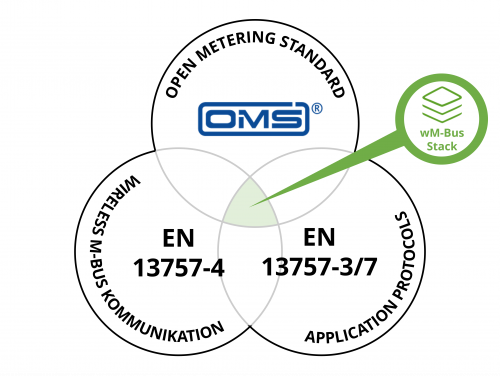
Der Wireless M-Bus Stack deckt einen Großteil der Optionen und Features der europäischen Norm EN 13757 und der OMS-Spezifikation ab.
EN 13757-3/-4/-7: Basis für drahtlose Kommunikation
OMS Spezifikation Version 4.2.1: Aktuell unterstützt, Version 4.3.3 in Entwicklung (Q2/2022)
Sub-Standards auf Anfrage: DSMR, ESMR, CIG UNI/TS 11291-11-4 PM1 u. v. m.
Die Nutzung der OMS-Spezifikation garantiert herstellerübergreifende Interoperabilität, einfache Netzwerkerstellung und die Nutzung zusätzlicher Frequenzbänder für internationale Anwendungen.
Das Wireless M-Bus Stack Angebot
Das Stack-Paket enthält:
Vorkompilierte Stack-Bibliothek
Hardware-spezifische Treiber
Serielle Schnittstelle und Power Management
App-Ordner „Example“ (Integration in eigene Firmware)
App-Ordner „Modem“ (Firmware für Zwei-Chip-Designs)
Nutzung im Single- oder Zwei-Chip-Design:
Single-Chip: Stack-Bibliothek direkt in Anwendung integriert
Zwei-Chip: Modem-App erstellt Firmware für Kommunikations-Controller, Host greift auf Protocol Stack zu
Zugriffe bei Erwerb:
Protokoll-Stack: Objektcode
RF-Treiber: Objektcode
HAL: Quellcode
12 Monate Wartung inklusive, weitere Support-Leistungen je nach Lizenzmodell
Betriebsmodi und Flexibilität
Modi S, T und C: Wahl der Betriebsart je nach Anwendung
Richtungen unidirektional/bidirektional: Anpassbar zur Laufzeit oder Kompilierzeit
Synchrone Intervalle: Hardware-Timer-Kompensation und automatische Paketverwaltung
Der Stack unterstützt alle gängigen Festspeicherarten (EEPROM, Flash, MRAM) und lässt sich für plattformspezifische Optimierungen konfigurieren (AES, CRC-16, Manchester-/3-out-of-6-Codierung).
STACKFORCE launches the new OMS® v5.0.1 Dual Stack – combining LPWAN UL-S1/S2 and Wireless M-Bus C1 for maximum interoperability, extended range, and future-proof smart metering.
Smart Agriculture: Efficiency and sustainability through digital farming technologies
Modern agriculture faces enormous challenges: rising demand, increasing weather extremes, limited resources, growing water scarcity, and intense price pressure. At the same time, markets and society demand greater transparency, sustainability, and efficiency.
Smart Industry: Robust communication for harsh industrial environments
Connected supply chains and mobile assets demand full transparency and agility. IoT-driven solutions using LPWAN technologies enable energy-efficient, scalable monitoring and control of transport and warehouse processes - anytime, anywhere. This makes smart logistics the foundation for global markets and just-in-time production.
Smart Logistics: Connected supply chains and mobile assets always in sight
IoT-enabled trackers, sensors, and gateways turn transports, assets, and warehouse operations into fully digital, always‑connected processes. But especially in distributed, fast‑moving networks, one thing becomes clear: Smart Logistics is only as powerful as the middleware that supports it.